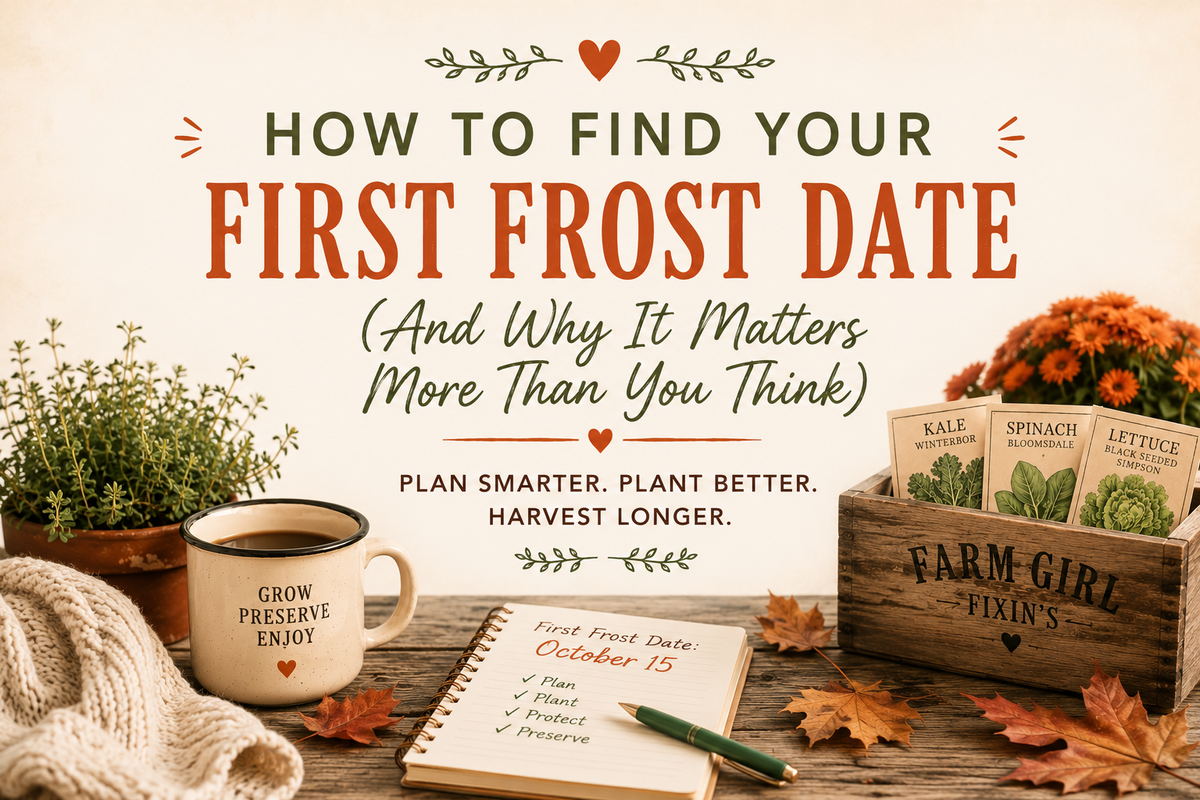
How to Find Your First Frost Date (And Why It Matters More Than You Think)
Don't let an early frost catch you by surprise. Learn how to find your first frost date, plan your fall garden, and harvest with confidence all season long.
If you've ever planted a fall garden only to have an unexpected frost cut your season short, you're not alone.
One of the biggest differences between gardeners who seem to have endless harvests and those who constantly feel like they're running out of time comes down to one simple piece of information ~ their average first frost date.
The good news is you don't need to be a weather expert to figure it out.
Once you understand what your first frost date is and how to use it, planning your fall garden becomes much less of a guessing game. Instead of wondering whether you still have time to plant carrots or spinach, you'll know exactly how many growing days you have left before colder temperatures arrive.
In this Farm Girl Guide, I'll show you how to find your average first frost date, explain why it's one of the most valuable gardening tools you can have, and help you use it to grow a more successful fall garden.
🌾 Table of Contents
Grab your favorite cup of coffee and stay awhile. Here's everything we'll cover together...
🌾 Who This Guide Is For
This guide is for you if...
- 🌱 You're planting your very first fall garden.
- 🍅 You've lost vegetables to an early frost before.
- 📅 You're tired of guessing when to plant.
- 🥬 You want to grow more food before winter arrives.
- 🏡 You're learning to become more self-sufficient one season at a time.
If that sounds like you, grab a notebook because this one simple date is about to make gardening a whole lot easier.
🍂 What Is a First Frost Date?
Your average first frost date is the average calendar date when your area typically experiences its first light frost of the season.
The key word here is average.
It isn't a prediction.
It isn't a guarantee.
Instead, it's based on many years of historical weather data collected in your area.
Think of it like this...
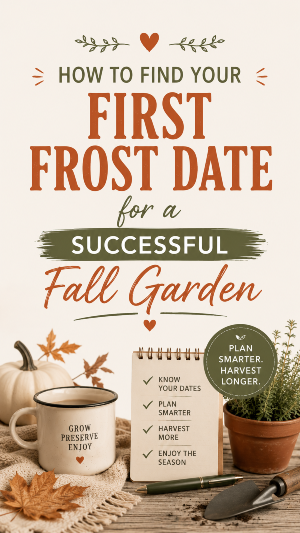
If your average first frost date is October 15, that doesn't mean frost will always happen on October 15.
Some years it might arrive on October 5.
Other years it may not happen until late October.
The average simply gives gardeners a reliable planning point.
Once you know that date, you can work backward to decide what still has enough time to mature before frost arrives.
It's one of the easiest ways to take the guesswork out of gardening.
🌾 From My Garden Gate
I used to think experienced gardeners just had incredible instincts.
It seemed like they always knew exactly when to plant and somehow managed to harvest vegetables right up until winter.
Then I learned their secret wasn't luck at all.
They were simply planning around their average frost dates.
Once I started doing the same thing, fall gardening became so much less stressful.
🌱 Why Your First Frost Date Matters
Knowing your average first frost date helps you answer one of the biggest questions every gardener asks in late summer:
"Do I still have time to grow this?"
Without knowing your frost date, every planting decision becomes a guess.
With it, you can confidently choose vegetables that have enough time to mature before cold weather slows them down.
Understanding your frost date helps you:
- Plant cool-season vegetables at the right time.
- Avoid wasting money on seeds that won't mature.
- Know when to start protecting tender plants.
- Plan succession plantings.
- Harvest more food before winter.
- Reduce frustration and disappointment.
One little date really can make a big difference.
🌱 Take Root
Learning your first frost date isn't about adding another complicated gardening rule.
It's about replacing uncertainty with confidence.
Once you know your average frost date, every seed packet suddenly makes a lot more sense.
📅 How to Find Your First Frost Date
Finding your average first frost date is surprisingly easy.
Start by locating your ZIP code or your nearest town.
Then use a trusted frost date calculator or simply Google average frost date + zip code.
Once you've found it, write it somewhere you'll actually see it.
I like keeping mine inside my garden journal, but you could also write it on a calendar, save it in your phone, or even tape it inside your seed storage box.
Now comes the fun part.
Instead of counting forward from planting day, you'll begin counting backward from your frost date.
For example:
If your average first frost date is October 15 and spinach takes about 45 days to mature, you'll know you should plant around the beginning of September.
Do that for each crop, and suddenly your entire fall garden plan comes together.
It feels almost like solving a puzzle and once you've done it once, you'll wonder how you ever gardened without it.
🤎 Just Between Us...
Can I let you in on a little secret?
I used to think gardening success came from having a "green thumb."
Now I know it's mostly about having good information.
Knowing your frost date won't guarantee a perfect garden, but it will help you make much better decisions.
And that's something every gardener can do.
❄️ First Frost vs. First Freeze
One of the most confusing parts of fall gardening is hearing the weather forecast talk about frosts and freezes as if they're the same thing.
They're actually a little different, and understanding the difference can help you know when to cover your plants and when it's time to harvest everything that's left.
🌱 Light Frost
A light frost usually happens when temperatures dip to around 32°F (0°C) for a short period.
Tender plants like tomatoes, peppers, basil, and cucumbers may show damage after a light frost, while many cool-season vegetables barely notice.
❄️ Hard Frost (or Killing Frost)
A hard frost occurs when temperatures stay below freezing long enough to kill tender plants.
For warm-season vegetables, this usually marks the end of the growing season.
🧊 Hard Freeze
A hard freeze typically means temperatures remain below 28°F (-2°C) for several hours.
At this point, most warm-season crops are finished, while many cool-season vegetables continue growing surprisingly well.
One of my favorite things about fall gardening is discovering that some vegetables actually become sweeter after a frost.
Kale, spinach, carrots, Brussels sprouts, and parsnips often improve in flavor as cooler temperatures encourage the plants to convert starches into natural sugars.
🌾 From My Garden Gate
The first time someone told me to leave my kale out after a frost, I thought they were joking.
Turns out...they were right.
Some of the sweetest kale I've ever picked came after those cool autumn nights. Nature has a funny way of reminding us that not everything is ruined by a little cold.
Sometimes it actually gets better.
🧮 How to Count Backward From Your Frost Date
Now that you know your average first frost date, it's time to put it to work.
This is where gardening suddenly starts feeling much less like guessing.
Let's use a simple example.
Imagine your average first frost date is October 15.
Now look at the seed packet for the crop you want to grow.
If it says:
- Spinach — 45 days
- Radishes — 30 days
- Lettuce — 50 days
- Beets — 55 days
Simply count backward from October 15.
That gives you an approximate planting date for each crop.
🌱 Fall Garden Planting Example
| Vegetable | Days to Maturity | Plant By |
|---|---|---|
| 🥕 Radishes | 30 days | September 15 |
| 🌿 Spinach | 45 days | September 1 |
| 🥬 Lettuce | 50 days | August 26 |
| ❤️ Beets | 55 days | August 21 |
*Example based on an average first frost date of October 15. Always check your own seed packet and local frost date before planting.*
Suddenly, instead of wondering if you still have time, you know.
That confidence is one of the biggest gifts your frost date gives you.
🧺 Harvest Basket
Write your average first frost date inside every seed catalog, garden journal, or seed storage box you own.
You'll refer to it over and over again, and having it handy makes planning your fall garden much easier.
🌿 Don't Forget About Microclimates
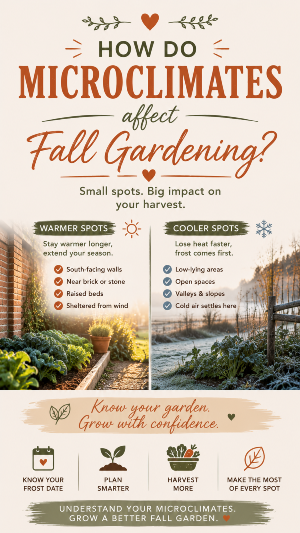
Here's something many beginner gardeners don't realize.
Not every part of your yard experiences frost at exactly the same time.
These small differences are called microclimates, and they can extend (or shorten) your growing season.
For example, plants growing:
- Along a south-facing wall
- Near a brick building
- In a raised bed
- Close to a fence that blocks the wind
may stay warmer than plants growing in an open part of the yard.
On the other hand, low spots in your yard often collect colder air and may experience frost first.
The more time you spend observing your own garden, the more you'll begin to notice these little differences.
That's one of the reasons gardening gets easier every year.
You're not just growing vegetables.
You're getting to know your own little piece of the world.
🤎 Just Between Us...
One thing I've learned is that Mother Nature doesn't always read the calendar.
Some years frost comes early.
Some years it arrives weeks later than expected.
Don't let that discourage you.
Your average frost date is a planning tool, not a promise.
The more seasons you garden, the more you'll learn to watch the weather and trust your own observations right alongside the averages.
❓ Frequently Asked Questions
What is an average first frost date?
It's the average date your area typically experiences its first frost based on historical weather records.
Is my first frost date guaranteed?
No. It's an average based on past weather patterns. Frost may arrive earlier or later in any given year.
Where can I find my frost date?
A trusted frost-date calculator, your local extension office, or Googling average frost date + your zip code are great places to start.
Can vegetables survive frost?
Many cool-season vegetables like kale, spinach, carrots, and Brussels sprouts tolerate light frost very well. Warm-season crops like tomatoes, peppers, and basil usually do not.
What happens if an early frost is predicted?
Cover tender plants with frost cloths, row covers, or old sheets if possible. If a hard freeze is expected, harvest warm-season crops before temperatures drop.
🤎 Final Thoughts
Learning your average first frost date is one of the simplest things you can do to become a more confident gardener.
Instead of wondering whether you have enough time to grow another crop, you'll be making decisions based on information—not guesswork.
And that's what gardening is really about.
Learning a little more each season.
Trying something new.
Celebrating the wins.
Learning from the surprises.
Then doing it all again next year.
Your frost date isn't there to limit what you can grow.
It's there to help you make the most of every growing day you have.

🌾 Farm Girl Next Steps
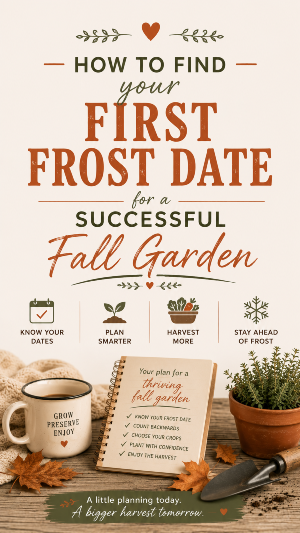
Now that you know your average first frost date, you're ready to start planning a thriving fall garden.
🌾 Until Next Time...
Keep growing,
keep preserving,
and keep making homemade happiness.
Because every thriving garden began with someone willing to plant one little seed.
I can't wait to see what grows in yours.
❤️ Julie
Founder of Farm Girl Fixin's
Helping you grow, preserve, and create homemade happiness...one season at a time.
🍓 Let’s Stay Connected
If you love simple, homemade, from-scratch goodness, you’ll fit right in here.
I share freeze drying tips, zero waste kitchen ideas, and all the little farm girl fixin’s along the way 👩🏻🌾
💛 Join me on Facebook
🎥 Watch on YouTube
🌿 Follow along on TikTok
📌 Save ideas on Pinterest
🛒 Shop my Amazon favorites
✉️ Grab my free kitchen tips + join my list
Just a little heads up, friend...some of the links on this page may be affiliate links. That means if you grab something through them, I may earn a small commission (at no extra cost to you). It’s basically like you buying me a coffee while I share all my favorite cozy kitchen finds with you. I only ever recommend what I truly love and use myself.